

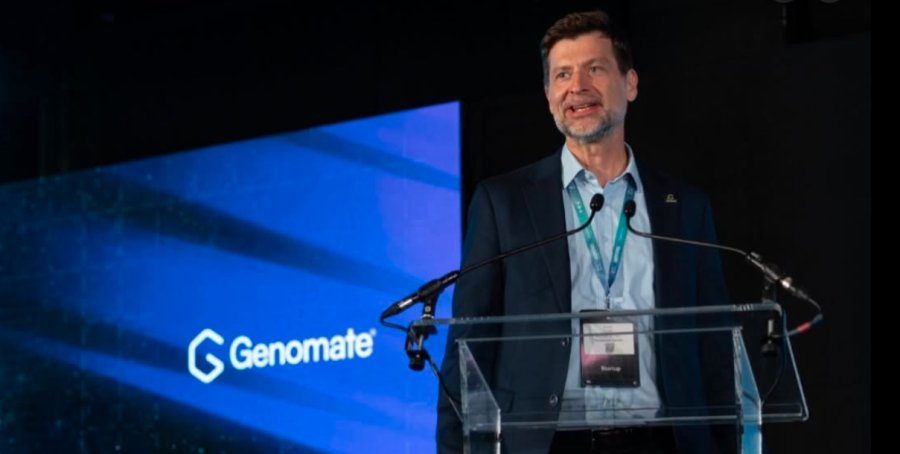
Genomate, a precision oncology project from Hungary, has won first place in the health category of the BE100 competition at the Blue Earth innovation conference in London. The conference focuses on the future of our planet and of humanity.
How the competition worked
This year, 1,414 innovative companies applied, offering solutions in fields such as food, transport and energy. From this pool, 100 outstanding innovators were selected. In the health category, ten semifinalists were then chosen based on their applications.
Dr. István Peták, who leads the team, was invited to present their work on stage in front of an international field. The winner was decided by an international jury together with the audience vote, and Peták accepted the first prize on behalf of the team.
The problem, in plain terms
Cancer is driven by molecular changes inside cells that alter how those cells behave. Over the years, researchers have identified many of these changes, and there are now numerous drugs designed to act against them. This is what “targeted treatment” means: a therapy aimed at a specific fault in the tumor rather than at cancer in general.
The difficult part is no longer only finding drugs. It is choosing among them. Every tumor has a complex combination of characteristics, and the open question is which treatment has the best chance of helping one particular patient. Peták has spent thirty years working on how to find the right targeted treatment for every cancer patient.
What Genomate is for
The team’s approach is to use mathematics, logical reasoning and the computing power of computers to tackle this question. Genomate is being built for two groups. The first is physicians, who need help selecting the right therapy for a patient. The second is drug developers, who need to find the patients for whom a new treatment could be most useful.
“This victory belongs to the whole team”
Peták was the one on stage, but he stressed that the win belongs to everyone involved: his colleagues’ years of work, the knowledge of the collaborating physicians, and the patients whose stories remind the team daily why they cannot give up.
He also said it was a particular source of pride, as a Hungarian physician and researcher, to show in London that knowledge developed in Hungary can contribute to one of humanity’s greatest challenges: beating cancer.
He was careful not to oversell the moment. In his view, the award only becomes truly meaningful if it ends up benefiting patients, and there is still a great deal of work ahead. What the win gives the team, he said, is renewed energy to keep working toward the goal that matters most: every cancer patient being able to find the treatment that fits them.
Transparency Note: This article was prepared with the assistance of artificial intelligence technologies. Every piece is thoroughly reviewed and verified by our editorial team, who retain full responsibility for the final content.
Picture: Gemini AI