

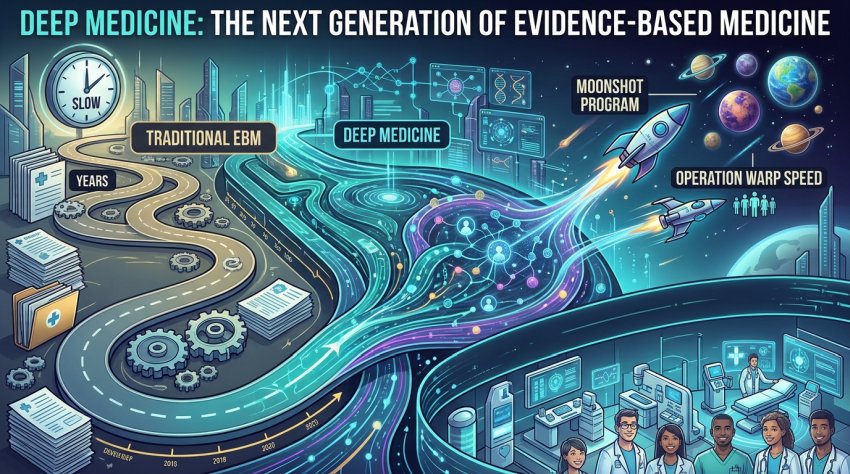
Deep medicine: in a recent thought-provoking social media post, Dr. Bertalan Meskó, founder of The Medical Futurist, highlighted a central visual figure from a landmark perspective published in Nature Medicine by renowned oncology and clinical trial expert Dr. Vivek Subbiah.
Emphasizing how effective visual graphics can convey complex healthcare paradigms far better than lengthy academic manuscripts, Meskó drew attention to what Subbiah identifies as the era of the next generation of “deep medicine”.
At the heart of this discussion is the urgent need to modernize traditional evidence-based medicine (EBM). While the established clinical trial framework has served as the gold standard of clinical research for decades, its rigid protocols, slow recruitment timelines, and high financial costs are increasingly out of step with the rapid expansion of genomics, multi-omics profiling, and advanced data science. As digital technology penetrates every level of healthcare, artificial intelligence (AI) offers the necessary capabilities to re-engineer clinical trials from the ground up.
Redefining Evidence-Based Medicine: Key Insights from Dr. Vivek Subbiah’s Research
Dr. Vivek Subbiah’s paper, titled “The next generation of evidence-based medicine” (Nature Medicine, Vol. 29, 2023, DOI: 10.1038/s41591-022-02160-z), outlines a heuristic vision where AI, machine learning, wearable monitoring tools, and real-world data (RWD) collapse the historical boundary between experimental clinical trials and everyday patient care.
In the post spotlighted by Dr. Meskó, Dr. Subbiah forcefully argues that existing clinical paradigms must be continuously challenged by emerging technologies and all primary stakeholders—including rising generations of scientists, physicians, pharmaceutical companies, regulatory agencies, and, most importantly, patients.
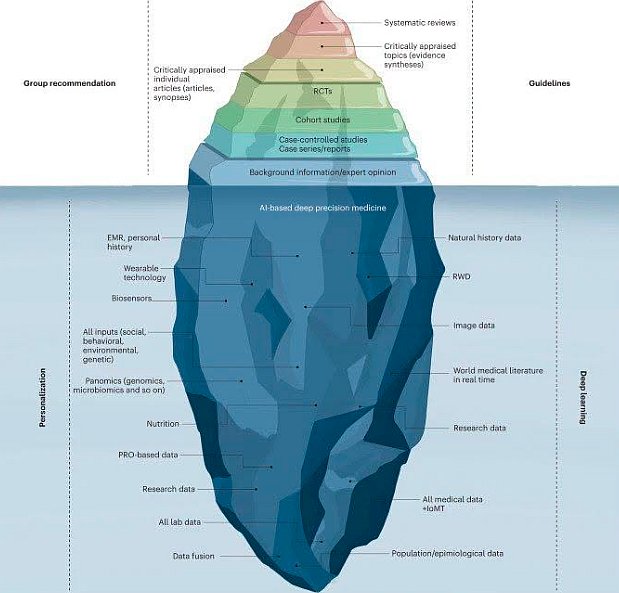
Several core pillars define this proposed transformation:
- Every Clinical Site as a Research Site: A foundational element of disruptive innovation in modern healthcare is embedding trial infrastructure directly into routine care. Supported by AI-driven data collection, continuous quality checks, and real-time electronic health record (EHR) analytics, every local medical practice and community hospital can function as an active clinical trial node, significantly democratizing trial access.
- Targeted Acceleration via ‘Moonshots’ and ‘Warp Speed’: Subbiah advocates for mission-driven, structural frameworks to address health challenges. Major high-burden human diseases require dedicated “Moonshot” programs, while rare diseases—which frequently suffer from delayed drug development—demand an “Operation Warp Speed” approach. Crucially, both strategies must maintain clear, sustainable goals to advance population health while actively addressing inequities in diversity and global treatment access.
- Generating ‘Deep Evidence’ for Personalized Healthcare: Traditional EBM often relies on broad statistical averages from trial populations that may not capture individual biological nuance. Next-generation AI models process complex, multi-layered patient data—from genomic alterations to longitudinal real-world evidence—creating “deep evidence.” This approach fulfills the ultimate goal of precision medicine: providing the right treatment to the right patient at the right time.
Why Digital Health Leaders Are Championing the Paradigm Shift
As Dr. Meskó emphasizes, clear communication is essential to translate advanced computational concepts into actionable healthcare practices. Complex methodologies such as AI-assisted trial design, adaptive basket trials, and N-of-1 trial models require clear conceptualization to bridge the gap between medical researchers, clinicians, regulators, and the public.
By bringing attention to Subbiah’s work, The Medical Futurist reinforces a critical message: technology alone is not a panacea. The evolution of evidence-based medicine requires a unified commitment across the global health ecosystem to reform obsolete methodologies and build a faster, more inclusive, data-driven clinical research paradigm.
Original source:
https://www.nature.com/articles/s41591-022-02160-z
Transparency Note: This article was prepared with the assistance of artificial intelligence technologies. Every piece is thoroughly reviewed and verified by our editorial team, who retain full responsibility for the final content.
Picture:Gemini AI