

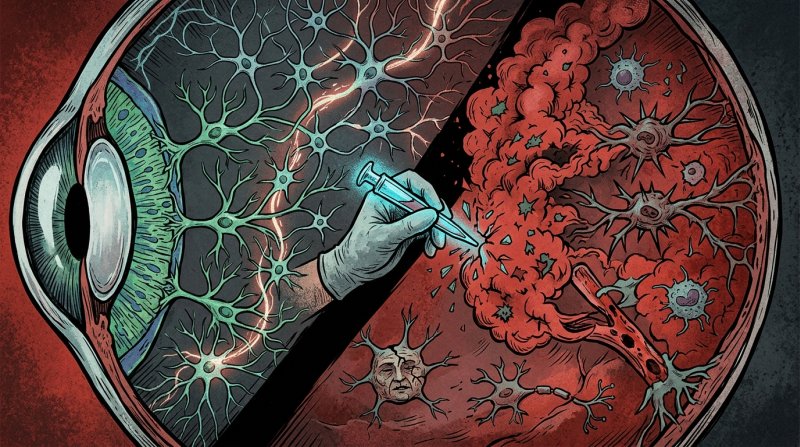
Researchers hope to repair the nervous system by turning support cells into new neurons. But a mouse study shows the trick works much worse in older animals, because their cells react with inflammation instead of renewal.
Most experiments on this idea have used young mice, while the diseases it aims to treat mostly hit older people. A study published in PNAS (pnas.org) on 26 August 2026 tested it in aged mice and found the method was far less effective. The finding was also discussed in a September post on the longevity news site Fight Aging!, written by Reason.
The idea: turn helpers into neurons
Glia are the supporting cells of the nervous system. The plan is to reprogram them into neurons, which could replace cells lost in age-related neurodegeneration. New neurons could restore lost function by joining the existing neural circuits. The field is still at an early stage.
Why the test in older animals matters
Ageing is the biggest risk factor for neurodegeneration, yet the authors say most of this work has been done in young animals. So a basic question was still open: does the approach work in older tissue?
The test: mouse eyes
The researchers used the retina, the light-sensing layer at the back of the eye, as an easy-to-reach part of the central nervous system. They tried three different reprogramming methods on Müller glia, the retina’s main support cells. All three methods gave the same result: aged cells made consistently fewer new neurons than young ones.
Old cells choose inflammation
By reading gene activity in single cells, the team saw what went wrong. Young glia can be pushed into a “progenitor” state, a flexible, almost stem-cell-like condition from which new neurons can grow. Aged glia did not switch on those programmes. Instead, they turned reactive and inflammatory.
The surroundings fight back too
The problem was not only inside the cells. After injury, the aged retina also mounted an exaggerated immune response. The authors conclude that ageing sets up two barriers: one within the glia, and one in the surrounding tissue. Reason adds that chronic inflammation and changes in glial cells both reduce reprogramming efficiency, and that any future therapy will have to deal with them.
A partial fix
The team treated the mice with dexamethasone, a drug that calms the immune system. It partially restored the growth of new neurons. So the barriers can be eased, but not removed.
What this means, and what it doesn’t
The message for researchers is that regeneration therapies need to be tested in aged tissue, and may need to tackle inflammation as well.
This is still a mouse study, done in the retina. The abstract makes no claim about treatments for people, and it does not say whether the new neurons work fully.
Original Source:
https://www.pnas.org/doi/10.1073/pnas.2612369123
Transparency Note: This article was prepared with the assistance of artificial intelligence technologies. Every piece is thoroughly reviewed and verified by our editorial team, who retain full responsibility for the final content.
Picture: Gemini AI