

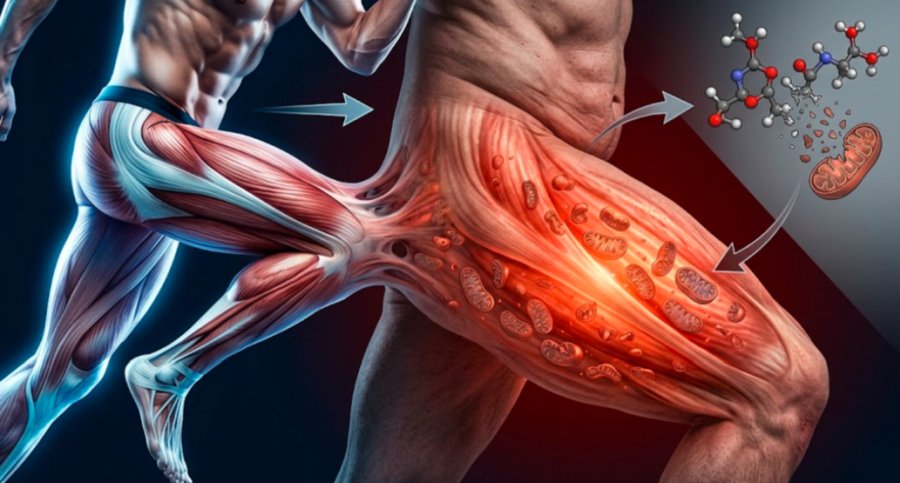
Muscles don’t just get weaker with age, they change character. New research in mice points to one surprising culprit: a fat molecule tucked inside our cells’ power plants.
Weaker power plants, yet more of them
Every muscle cell is packed with mitochondria, tiny power plants that turn fuel into energy. As we age, these power plants work less well. You would expect muscle to lose them. Strangely, the opposite happens: ageing muscle drifts towards fibres that contain lots of mitochondria and away from fast fibres that rely on a different way of making energy. Scientists couldn’t explain why a failing system would lead to more of the very thing that is failing.
The missing piece: a fat called cardiolipin
The researchers zeroed in on cardiolipin, a special fat that forms part of the wall of the mitochondria. Its levels in muscle fall as we get older.
To see whether this drop was a cause or just a side effect, the team lowered cardiolipin in young mice by switching off a gene called Crls1. The young animals’ muscles started to look and behave like those of old mice. Fast fibres turned into slower, mitochondria-rich ones.
An alarm sent to the cell’s control room
The study also reveals how this happens. When cardiolipin runs low, the mitochondria send a warning signal to the cell nucleus, the cell’s control room, through a hormone receptor called ERRγ. The signal tells the cell to take in and process more sugar, which helps it keep its antioxidant defences up. That, in turn, pushes the muscle towards the mitochondria-rich fibre type.
Turning the clock back
The most striking result came when the researchers restored cardiolipin production in the mice. The muscle wasting began to reverse, and the animals were protected from dying early.
What it means for people
These were experiments in mice, so it is too early to say whether the same approach would work in humans. Still, the findings suggest that a single molecule plays a central role in how muscle ages. That gives scientists a new lead for understanding sarcopenia, the gradual loss of muscle in older age, and possibly other muscle diseases.
Source:
https://www.nature.com/articles/s43587-026-01227-7
Transparency Note: This article was prepared with the assistance of artificial intelligence technologies. Every piece is thoroughly reviewed and verified by our editorial team, who retain full responsibility for the final content.
Picture:Gemini AI