

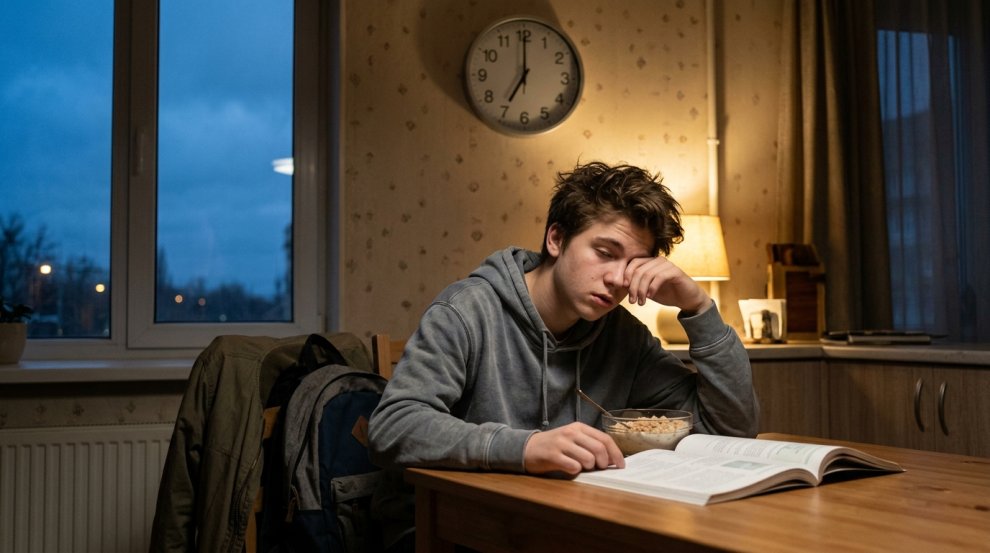
Under Hungarian rules, a school day may begin as early as 7:15 a.m. A physician-turned-entrepreneur says that has to stop. What does the science say?
A physician by training, health-care entrepreneur and former economy minister, János Kóka argued in a recent Facebook post that teenagers need 8–10 hours of sleep but are expected in class very early. Their body clocks, he wrote, make going to bed that early nearly impossible. His conclusion: early starts should be banned. global-diplomacy-lab
What the evidence says
The biology is well documented. At the start of puberty, the sleep-wake cycle can shift up to two hours later. The American Academy of Sleep Medicine recommends 8 to 10 hours of sleep for teens aged 13 to 18. Think of it as a body clock that simply runs later during the teen years: a teenager lying awake at 10 p.m. is not necessarily being difficult. enewspfaasm
The big medical bodies agree on the remedy. The American Academy of Pediatrics recommends that middle and high schools start at 8:30 a.m. or later. The American Medical Association adopted a similar policy. So did the sleep-medicine academy aap recommends delaying school start times combat teen sleep deprivation.
Hungarian data point the same way. According to an earlier national HBSC survey, 11th graders sleep about 7.1 hours on school days – weborvos
What Hungarian rules actually say
Kóka cites a ministerial decree, and he is right about the wording. It allows the first lesson to begin up to 45 minutes before 8 a.m., after the school consults its board, parents and student council. That makes 7:15 the earliest legal start. But no law fixes the start time itself: the ministry told a Hungarian news site in 2018 that schools are free to start later and that it did not plan a national rule. In practice, most schools are built around a start of about 8 a.m. – 20/2012. (VIII. 31.) EMMI rendelet
A reality check
Whether to ban early starts is a policy question, and the evidence has limits. Experts writing in Telex this week noted that many studies are observational, rely on self-reported sleep and mostly come from the US, usually testing delays of just 15 to 30 minutes. They also noted that Hungary has had no pilot program of its own. The practical hurdles are real too: transport, parents’ and teachers’ working hours, and after-school sports. The experts suggest starting with pilots, limiting early “zeroth” lessons, or staggering start times by grade. A Hungarian expert group called Nekem9 is already pushing for a 9 a.m. start. More on: Telex: Nem lusták, csak túl korán ébresztjük őket
The bottom line: the core of Kóka’s argument is backed by leading medical organizations. How to change school schedules, and how fast, is still open. What do You think?
Sources:
- János Kóka, Facebook post, October 2026
- American Academy of Pediatrics, “School Start Times for Adolescents,” Pediatrics, 2014
- American Medical Association, policy on school start times
- American Academy of Sleep Medicine, position statement
- Telex, Nem lusták, csak túl korán ébresztjük őket, October 11, 2026
Transparency Note: This article was prepared with the assistance of artificial intelligence technologies. Every piece is thoroughly reviewed and verified by our editorial team, who retain full responsibility for the final content.
Picture: Gemini AI