

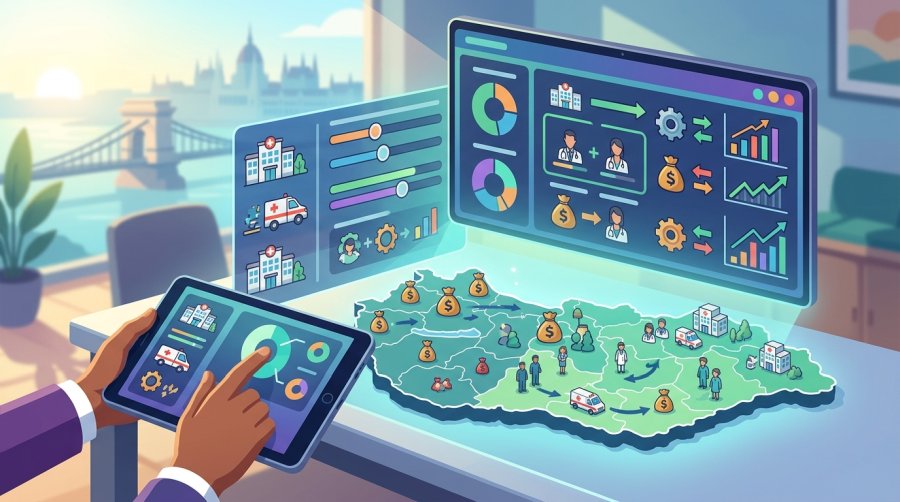
A former Hungarian economy minister has built an online game that lets anyone play health-care budget planner. According to his LinkedIn post, more than 700 budget plans have already been created.
The man behind it is János Kóka, chairman of the Doktor24 health-care group and a former minister of economy and transport.
The gap he wants to close
Kóka’s starting point is a funding gap. In the game, the “catch-up” target is public health spending equal to 7% of GDP by 2030. He has argued that approaching that level would take far more than the extra 500 billion forints a year, and he puts the cost of reaching the EU average at about 1,000 billion forints a year, saying he sees no sources for it today. Of course: that 1,000 billion figure is his own calculation.
Context helps. Last year’s OECD data show Hungary spending 6.5% of GDP on health, against an OECD average of 9.3%. That figure covers public and private spending together, so it cannot be compared directly with Kóka’s public-spending target.
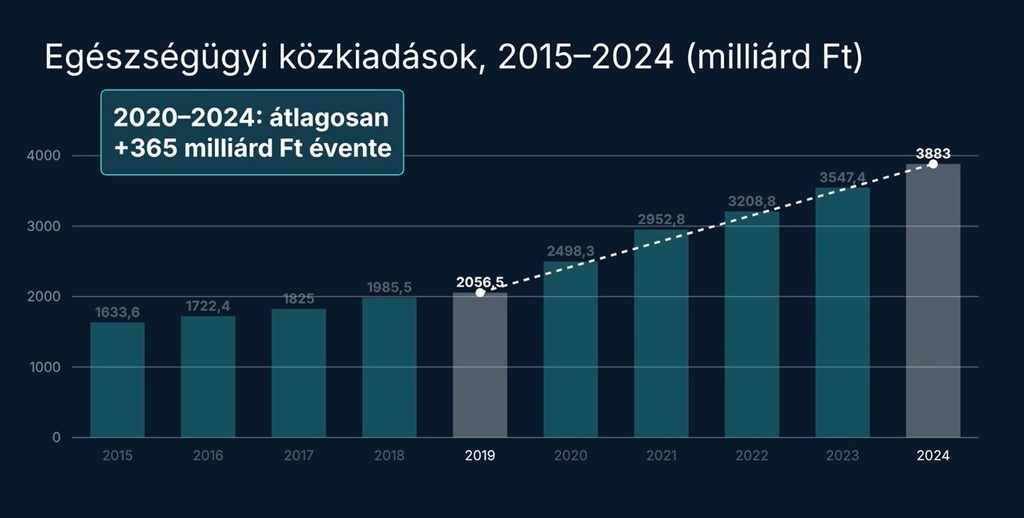
Previous year’s public healthcare spending is Hungary, HUF billion – see the chart below:
How the game works
Players split money among priorities such as nurses, primary care, prevention or reorganizing the national health insurance fund (NEAK). The game then shows modeled results for 2036: avoided deaths, life expectancy, waiting lists, vacant GP practices, and an overall score.
One plan shared in the comments, spending 636 billion forints a year, produced a modeled rise in life expectancy from 76.7 to 78.8 years. It also showed vacant GP practices falling from 1,021 to 499. The starting figure for vacancies matches the real data: in March 2026, 1,021 of 6,373 GP practices were unfilled.
What the game cannot tell you
Kóka is open about the model’s limits. In his replies to a commenter, he said
the game cannot reliably separate the effect of extra money from the effect of organizational reform. The improvements it shows follow from its built-in assumptions, which he says he will refine.
He also noted that extra spending brings diminishing returns, and that systems depend on each other: more screening needs more diagnostic capacity, and digitalization needs working processes and usable data.
His suggested order: first clarify who is responsible for what and how it is financed, while strengthening nursing and primary care, then adjust patient pathways, screening and hospital restructuring.
Important: treat the game as a way to think about trade-offs, not as a forecast. Its numbers show what its assumptions imply, not what will happen. Also note: the underlying funding figures also come from one expert, who runs a private health-care group.
Sources:
- János Kóka, LinkedIn post, October 2026, and the simulation game
- Telex, Kóka János: Nem omlott össze a magyar egészségügy…, September 10, 2026
- Portfolio, Elkerülhetetlen a fordulat a magyar egészségügyben, September 10, 2026
- OECD, Health at a Glance 2025: Hungary
- Világgazdaság, Háziorvosi rendszer: a végletekig leterhelve, August 2026
Transparency Note: This article was prepared with the assistance of artificial intelligence technologies. Every piece is thoroughly reviewed and verified by our editorial team, who retain full responsibility for the final content.
Picture: Gemini AI