

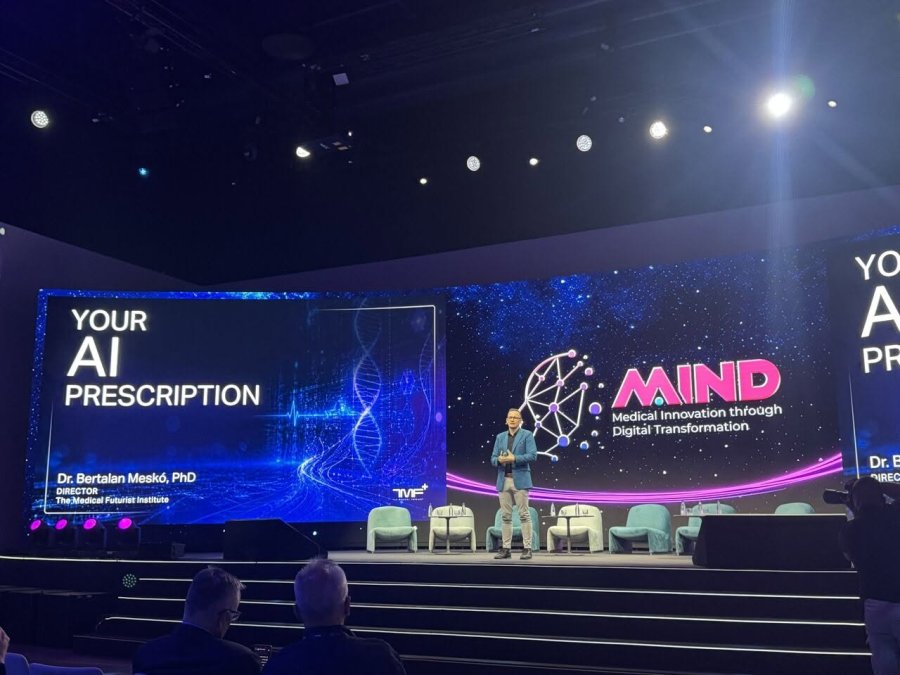
Medical futurist Bertalan Meskó spent a weekend in Belgrade, speaking at the new AI Mind conference about AI’s impact on healthcare. In a Facebook post afterwards, he shared the three questions that guided his preparation. They apply well beyond Serbia, since he notes that its health system is very similar to Hungary’s.
A talk built around questions
Meskó addressed health system leaders on what AI could change in the coming years. His post does not reveal his answers, only the questions he worked from:
- What must health system leaders hear about introducing AI, even if it is uncomfortable?
- Where can AI already provide real help in the short term?
- How can AI be used without radically transforming the whole health system?
Why they matter for our region
What follows is our reading of these questions, not Meskó’s own conclusions.
The first suggests that leaders need more than success stories. Adoption plans that skip the uncomfortable parts tend to stall, and a candid conversation is a sensible starting point.
The second points to concrete, near-term uses. Instead of asking whether AI will transform healthcare someday, it asks where it can help now, and the answer will differ by country and system.
The third may be the most practical for the region. It assumes that a technology which requires rebuilding the whole system first is unlikely to be adopted. Approaches that fit into existing workflows are more realistic.
Learning from a neighbour’s system
Meskó found it rewarding to apply his everyday work to another country’s health system, and called it a thought experiment. That has a lesson of its own. Because the Serbian and Hungarian systems resemble each other, a country-specific analysis for one can offer ideas for the other. Regional exchange, from conferences to shared experience, is a cheap way to test ideas.
A human touch
Meskó also met Daniel Kraft, one of the organisers of the Singularity University FutureMed course he attended in 2013. He described that programme as a mindset-shaping experience. Their stage conversation opened with the first questions coming from the AI model of the Sesame app, a small sign that AI can be a conversation partner as well as a subject of debate.
Takeaway
The value of the post is in its framing. Central Europe does not need to wait for a perfect strategy, but it should ask honest questions, look for quick wins and avoid plans that need a total overhaul.
Source: Bertalan Meskó’s Facebook post about a recent AI Mind conference in Belgrade.
https://www.facebook.com/BerciMesko
Transparency Note: This article was prepared with the assistance of artificial intelligence technologies. Every piece is thoroughly reviewed and verified by our editorial team, who retain full responsibility for the final content.
Picture: