

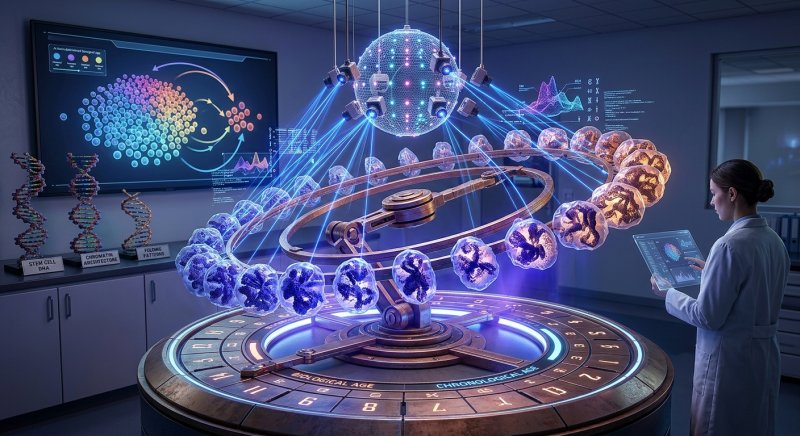
Scientists have trained an AI to look at microscope images of blood stem cells and tell whether they are young or old. The work could one day speed up the search for treatments that rejuvenate aging cells.
What is an aging clock?
An aging clock is a tool that estimates how old your body is biologically, which can differ from the number of candles on your birthday cake. Researchers build these clocks from almost any complex biological data that changes with age. Until now, the best-known aging clock models relied mostly on chemical tags on DNA or on blood markers. This new one works from pictures.
Why blood stem cells?
Hematopoietic stem cells live in the bone marrow and produce all of your blood and immune cells. As we age, they work less well, which weakens the blood and immune system and shortens the years we spend in good health. Measuring how old these cells really are is valuable for both research and medicine.
Reading the shape of DNA
Inside the nucleus, DNA is not a loose tangle. It is folded, packed tightly in some places and opened up in others, and this packing decides which genes are switched on. The folding pattern, known as chromatin architecture, changes as cells age. The researchers stained the nuclei of mouse stem cells with a fluorescent dye and took 3D microscope images of them. Then they trained an AI program called ChromAgeNet to tell young cells from old ones.
What the AI found
The model separated young and aged cells with moderate accuracy (an AUROC score of 0.77, where 0.5 is a coin flip and 1.0 is perfect). It beat older methods that relied on features picked by hand. Even better, the team looked inside the algorithm and found which clues it used: how disordered the chromatin is, how much tightly packed DNA hugs the edge of the nucleus, and the presence of small chromatin clumps called condensates.
Why this matters, and its limits
As a proof of concept, the researchers tested the model on aged stem cells treated with epigenetic drugs, to see whether it could spot signs of rejuvenation. If this works at scale, labs could screen many candidate anti-aging drugs quickly, simply by imaging cells. Keep in mind that the study was done on mouse cells, and the accuracy is far from perfect. It is a promising first step, not a test you can take at your doctor’s office yet.
Note: This article is adapted from Fight Aging!, “An Aging Clock Based on Images of Hematopoietic Stem Cell Nuclei” (October 2026), which covers a study published in Aging Cell
https://doi.org/10.1111/acel.70656
Transparency Note: This article was prepared with the assistance of artificial intelligence technologies. Every piece is thoroughly reviewed and verified by our editorial team, who retain full responsibility for the final content.
Picture: Gemini AI