

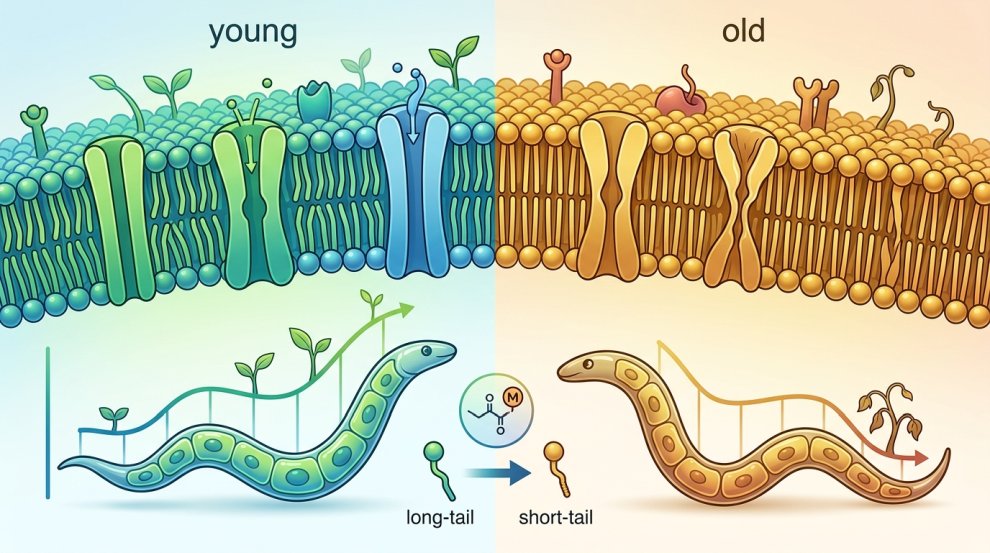
Scientists have found that the fatty molecules wrapping our cells grow longer as we age, and when researchers shortened them in tiny worms, the animals lived longer, a promising clue, though far from proof that the same would work in people.
Why do bodies wear out? Researchers have spent decades listing the culprits: damaged DNA, clumped-up proteins, cells whose tiny power plants are fading. A recent commentary in Nature Aging by Shanshan Pang points to a new suspect, and it hides in a place most of us never think about: the fats that make up our cell membranes.
What the research found
Every cell is wrapped in a thin skin of fatty molecules. Each of these molecules has long, tail-like chains, a bit like the bristles of a brush. Pang’s commentary discusses a study by Li and colleagues reporting that as animals age, these tails tend to get longer. The pattern shows up in several tissues and in species that are only distantly related. When the same change appears everywhere, scientists suspect it is not a coincidence but something fundamental.
Why would tail length matter?
Think of the membrane as a crowd of people standing shoulder to shoulder. Long, straight tails pack together tightly, so the membrane gets stiffer and lets less pass through. Shorter or kinked tails leave a bit of wiggle room, so the membrane stays flexible. That matters because the cell’s gates, sensors and delivery channels are all embedded in this skin, and they work best when it is supple. Earlier research has also linked membrane makeup to lifespan and to how easily the fats get damaged by oxygen, a process a bit like cooking oil going rancid.
From correlation to cause
Plenty of things change with age without causing it. What makes this study stand out is that the researchers did not just observe; they intervened. In a tiny roundworm often used in aging research, they manipulated the enzymes (called ELOVL) that stretch the tails longer. The worms ended up with shorter tails and lived longer. This suggests tail length may help drive aging, not just tag along with it, at least in worms.
A note of caution
Worms are not people. For now this is a promising idea, not a medical breakthrough. In mammals, fat metabolism is tangled up with energy storage, cell signaling and inflammation, and those enzymes are not interchangeable. Switching them off across the board could disrupt very long fatty acids that tissues like the brain and skin depend on. Nothing here shows that shortening these chains could safely extend human life, and it is no reason to change your diet or buy supplements.
If the pattern holds up in mammals, the makeup of our membranes could join the short list of aging features that appear adjustable. That is a big “if,” and the answer will take years to find.
Source:
Pang, S. “Lipid elongation as a hallmark of aging.” Nature Aging (2026), a commentary on the study by Li et al.
DOI: 10.1038/s43587-026-01229-5
Transparency Note: This article was prepared with the assistance of artificial intelligence technologies. Every piece is thoroughly reviewed and verified by our editorial team, who retain full responsibility for the final content.
Picture: Gemini AI