


A study of about 7,500 people found that ten different healthy eating styles were all linked to slower biological ageing. A Facebook post by János Kóka drew attention to it. The message: there is no single “best” diet, just better and worse ways of eating.
Mediterranean, Nordic, DASH, or cutting out all animal products? Former Hungarian minister János Kóka asked his followers which diet helps us age slowest, and pointed to a new study in Nature Communications by researchers at the German Center for Neurodegenerative Diseases (DZNE).
Two kinds of age
Your birthday count is your chronological age. Biological age describes how worn your body is, and it can run faster or slower than the calendar. The researchers estimated it from blood samples, using chemical tags on DNA that change in a predictable way over a lifetime. They used three different “epigenetic clocks”, which are tools that read these tags to estimate biological age.
What the researchers did
They studied about 7,500 women and men: 6,470 people in the Rhineland Study in Bonn, plus 1,034 in a second, independent group that confirmed the results. Instead of sorting people into diets, they scored how closely each person’s eating matched ten well-known healthy patterns. These included the Mediterranean diet, the Nordic diet, a plant-based diet, DASH (developed to lower blood pressure) and MIND (designed to protect the brain).
What they found
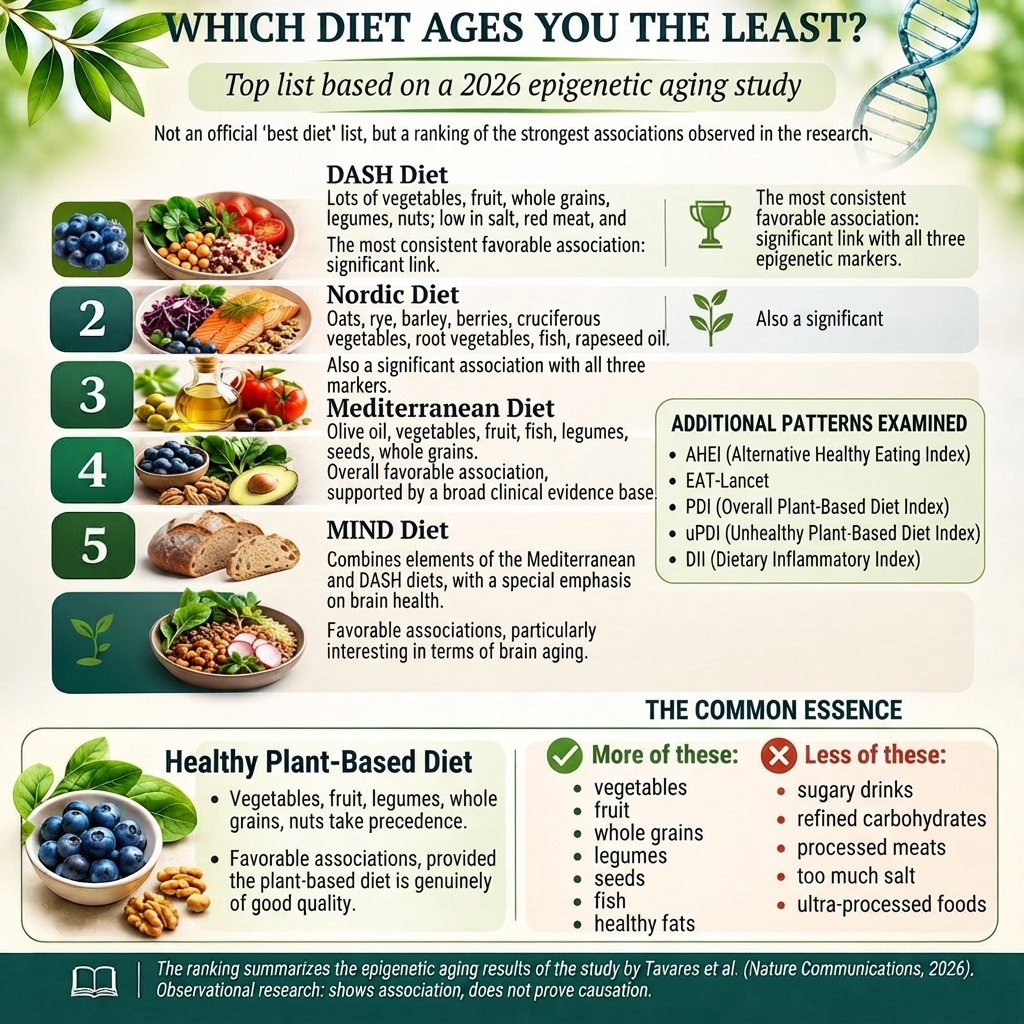
Eating closer to any of the ten patterns went with slower biological ageing. Kóka’s post puts DASH first and the Nordic diet a close second. The researchers’ own summaries say the differences between diets were small and that the overall picture matters more than the ranking, and I could not confirm the exact order from the press material.
Even more interesting, the diets were more alike than they look. Each was tied to its own set of DNA sites, but over 70 per cent of the affected body processes, such as how cells are built, how they send signals and how they handle energy, were shared. A few were unique: heart-related ones for DASH, and memory-related ones for MIND.
No need to be perfect
Hardly anyone in the study met the strictest rules of all the diets at once, and people did not need to. Following one healthy pattern reasonably well seemed to be enough, which is the practical message the lead author, Juliana Tavares, takes from it.
What it cannot prove
This was an observational study. It shows a link between healthy eating and slower-ageing markers, not that any diet adds years to your life. The link was also strongest in smokers, who may have more to gain from eating well. Kóka makes the same caution in his post.
What to take from it
Kóka’s takeaway is that you do not need costly longevity products, exotic “superfoods” or a punishing diet. The evidence points to a simple routine: more vegetables, fruit, wholegrains, beans and lentils and healthy fats, and less of sugary drinks, processed meat and salt. For readers in Central and Eastern Europe, the Nordic style’s rye, oats, cabbage and fish are not far from familiar local foods, so the study’s message of flexibility should be easy to put into practice.
This article is general information, not medical advice. If you have a health condition, talk to your doctor before changing your diet.
Transparency Note: This article was prepared with the assistance of artificial intelligence technologies. Every piece is thoroughly reviewed and verified by our editorial team, who retain full responsibility for the final content.
Images::Gemini AI,