

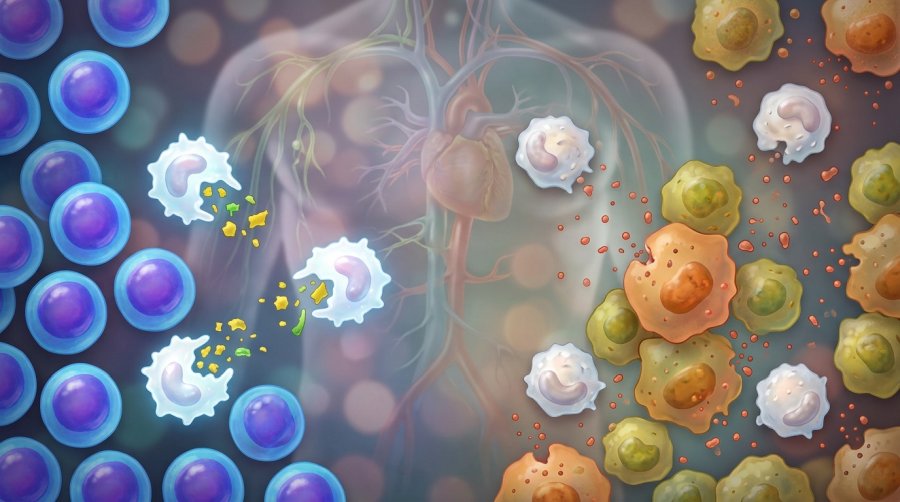
Every cell in your body has a built-in recycling system. A new study suggests that when this system slows down with age, “zombie cells” pile up, and the immune system loses the ability to clear them away.
What are zombie cells?
Cells get stressed, damaged, or simply worn out. When that happens, they can stop dividing. Scientists call them senescent cells, but “zombie cells” is easier to remember: they don’t die, they just linger.
In young people, this is actually useful. Stopping damaged cells helps prevent cancer, and the immune system quickly sweeps them away. With age, the cleanup crew gets sloppy. Zombie cells stay in our tissues and constantly release inflammatory chemicals that harm healthy neighbors. Even a small number can disrupt how a whole tissue works.
The recycling system that breaks down
Inside our cells runs a cleaning process called chaperone-mediated autophagy, or CMA. Think of it as a garbage service. Helper proteins, called chaperones, find broken or unwanted proteins and carry them to the cell’s “trash can,” the lysosome, where they are broken down.
CMA weakens with age in most tissues, and has been linked to brain diseases, metabolic problems, and clogged arteries. The new study shows it matters for zombie cells in two ways.
First, zombie cells with faulty CMA become even nastier. Their chemical signals push nearby healthy cells toward becoming zombies too.
Second, those signals shut down CMA in macrophages, the immune cells whose job is to “eat” zombie cells. With their own recycling broken, macrophages can’t swallow the zombies properly. This creates a vicious circle: old cells disable the very cleaners meant to remove them.
Testing the idea
The researchers worked with mice. When they blocked CMA only in macrophages, zombie cells built up, and wounds healed more slowly because the cleanup was delayed.
Then they tried the opposite. Giving older mice a drug that boosts CMA reduced the number of zombie cells. It also eased a lung-scarring disease (pulmonary fibrosis) in a mouse model.
Why it matters
Mouse results don’t always carry over to people, and this is early-stage science. No treatment based on it exists for humans yet. Researchers also still debate how much of the problem lies with aging immune cells versus the zombie cells themselves. This study suggests both play a part.
Still, the finding points to a promising idea. Instead of only destroying zombie cells, we might repair the body’s recycling machinery so it can do the cleaning on its own. Because CMA is a complex process, there are probably many ways future drugs could target it.
In short: when the cell’s trash service breaks down, the whole neighborhood suffers. Fixing the service may be a smarter way to keep tissues healthy as we age.
Source:
Transparency Note: This article was prepared with the assistance of artificial intelligence technologies. Every piece is thoroughly reviewed and verified by our editorial team, who retain full responsibility for the final content.
Picture: Gemini AI